
Traveling with luggage in Japan
Japan has seen a dramatic rebound in inbound tourism over the past few years. International arrivals have surged, supported by relaxed travel restrictions, a weak yen, and renewed global interest in Japanese culture, food, and pop media.
At the same time, the average length of stay for international visitors tends to be longer than that of domestic travelers, often ranging from one to two weeks*. Many visitors travel across multiple cities, carrying large suitcases designed for long international trips rather than short domestic journeys.
* The average duration is around nine days, but diverse stay patterns exist ranging from approximately one week to over 30 days.
As a result, certain destinations consistently rank as the most popular among foreign tourists.
Typical top destinations include:
- Tokyo – shopping, pop culture, and transport hub
- Kyoto – traditional culture, temples, and historic streets
- Osaka – food culture and convenient access to Kansai attractions
- (often followed by Mount Fuji / Hakone and Hiroshima)
While this growth is welcomed economically, it has also created unexpected friction in everyday public transportation, especially regarding large suitcases.
From Tourism Boom to Transportation Strain
Japan’s public transport system was designed around daily commuters and domestic travelers, who typically carry minimal luggage. Until recently, even in major tourist cities, large suitcases were relatively rare on buses and trains.
The rapid increase in overseas visitors has changed that balance.
Many foreign tourists travel with:
- Multiple large suitcases
- Hard-shell luggage with wheels
- Items sized for international flights rather than urban transport
When these are brought directly onto city buses, local trains, and high-speed rail, problems begin to surface.
Kyoto City Buses: A Local System Under Pressure
Kyoto provides one of the clearest examples of this issue.
Traditionally, Kyoto’s city buses were already crowded on weekends due to domestic tourism. However, domestic travelers rarely brought large suitcases onto buses, as many used coin lockers or hotel delivery services.
In contrast, international tourists often carry multiple large suitcases and use buses not only on weekends but also on weekdays. This has led to situations where:
- Local residents are unable to board buses during commuting hours
- Aisles and exits are blocked by luggage
- Elderly passengers and parents with strollers struggle to move safely
For residents who rely on buses for daily life, this has become a serious quality-of-life issue, not just a matter of inconvenience.
Shinkansen and Large Luggage: Rules vs. Reality
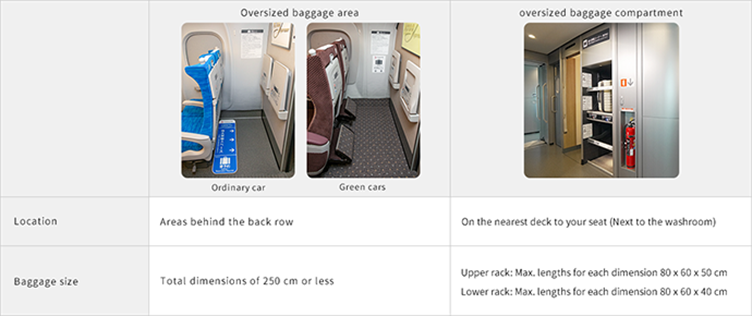
The Shinkansen is another major flashpoint.
While increased ridership from international tourists is generally welcomed, problems arise when large baggage rules are not understood or ignored.
Oversized Luggage Rules (Key Points)
- Luggage with total dimensions over 160 cm is classified as oversized
- Oversized baggage requires:
- Seats with designated oversized baggage space (often behind the last row), or
- Use of deck storage areas (pilot programs expanding from mid-2025)
- Placing oversized luggage in aisles or behind standard seats is not permitted
Common Problems Reported
- Blocked aisles: Suitcases left near doors or in walkways, obstructing movement
- Seat interference: Luggage placed behind seats without permission, preventing recline
- Unauthorized use of reserved spaces: Using oversized baggage areas without reservation
- Lack of awareness: Many incidents stem from unfamiliarity with the rules
Videos and photos of such situations frequently circulate on social media, sometimes escalating into online controversy.
Local and Urban Trains: Everyday Discomfort
On city and suburban trains, especially in Tokyo and other metropolitan areas, different issues appear.
Examples commonly cited by passengers include:
- Rolling suitcases placed directly on train seats, dirty wheels and all
- Two passengers occupying a four-seat box while storing large suitcases in the middle
- Standing areas dominated by luggage during rush hours
In these cases, available seats cannot be used, even though technically there is space. While not always illegal, such behavior clashes with unspoken norms of shared space in Japan.
Why This Problem Keeps Occurring
Several factors contribute to the persistence of the suitcase issue:
- Different travel norms
In many countries, carrying large luggage on public transport is common and accepted. - Information gaps
Rules about oversized baggage are often not clearly communicated in advance or understood at the point of use. - Cost and convenience
Some travelers avoid luggage delivery services due to cost concerns or lack of awareness. - Infrastructure mismatch
Urban buses and trains were not designed for today’s volume of international luggage.
Toward Better Coexistence: Possible Solutions
Addressing the suitcase problem does not mean discouraging tourism. Instead, it requires shared adaptation.
Possible measures include:
- Clearer multilingual signage and pre-arrival guidance
- Stronger promotion of luggage delivery services
- More storage infrastructure at stations and hotels
- Tourist education campaigns focused on transport etiquette
Tourism and daily life can coexist—but only when rules, expectations, and infrastructure evolve together.
Japan’s inbound tourism boom is a success story, but it has also revealed stress points in everyday systems.
The suitcase issue is not about blaming visitors—it is about recognizing that mobility habits, space, and cultural expectations differ.
By improving communication and encouraging considerate travel behavior, Japan can remain both welcoming to visitors and livable for residents.
Suitcase delivery services:
- Yamato Transportation (https://www.global-yamato.com/en/hands-free-travel/?_gl=1*1jsv1vn*_gcl_au*MTM1MzQ5ODE4OC4xNzY5MDA4NDIw)
A Growing Issue at Airports: Abandoned Suitcases Before Departure
Another serious luggage-related problem emerges at the very end of a trip.
Many international travelers find that, after weeks of shopping for souvenirs and clothing, their suitcases are too full to close. Faced with time pressure before departure, some choose to buy a new, larger suitcase—and leave the old one behind at the airport.
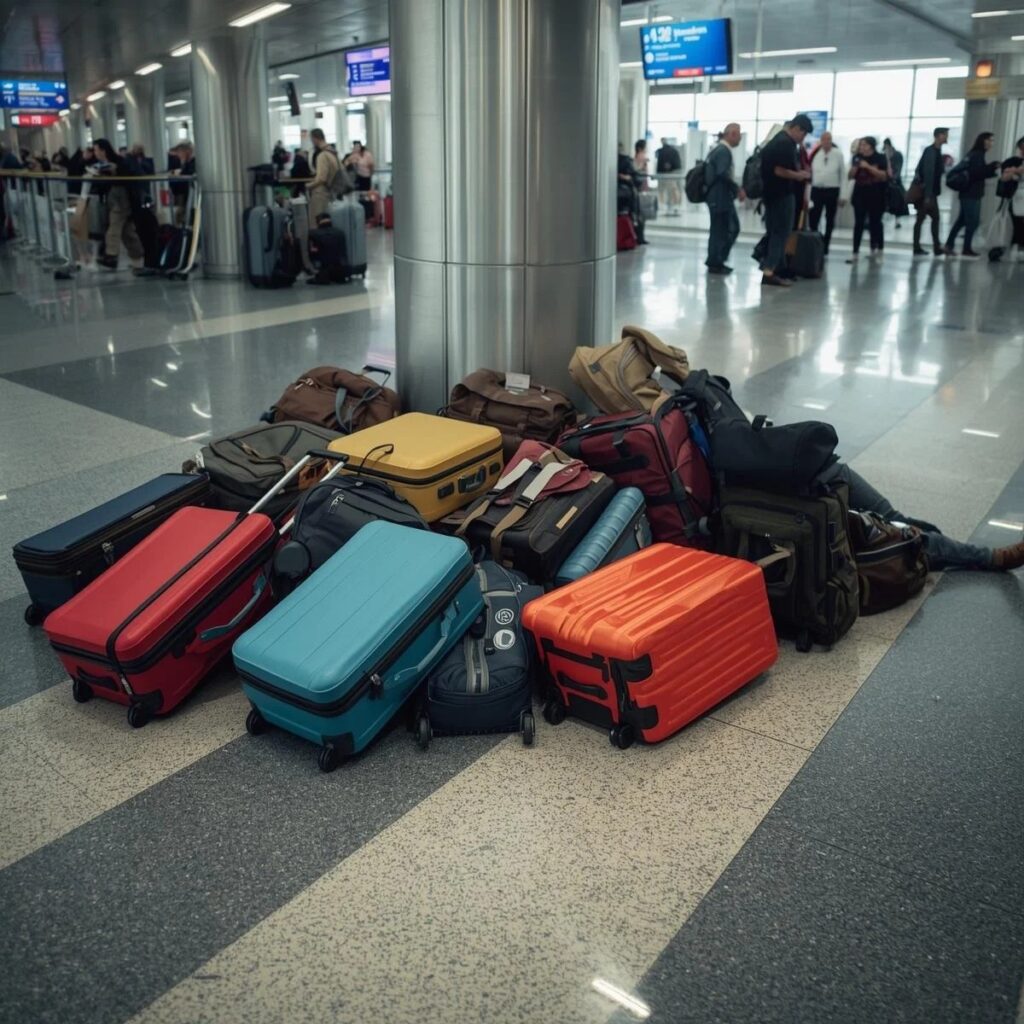
This practice has become increasingly common and has turned into a significant operational and environmental issue. Processing abandoned suitcases requires substantial time, labor, and disposal costs, placing a growing burden on airport operators.
An Innovative Solution: Clothing Compression Without Bags
To address this issue, new technology has recently attracted attention.
A Tokyo-based startup, SJOY, founded in 2019, (https://www.sjoy.info/) has developed a clothing-only automatic compression machine called Pocket Tips (https://www.sjoy.info/pockettips/about-pocket-tips).
Unlike traditional vacuum compression bags that remove air from sealed plastic, this machine compresses the clothing fibers themselves, significantly reducing volume without the need for bags.
According to CEO Ami Kawaguchi, garments can be compressed to as little as one-seventh of their original size, becoming small enough to fit in a pocket. Because no air-filled bags are used, the compressed clothes are not affected by air pressure changes during flights and simply washing them restores them to their original size.
Shirts, sweaters, and similar items can be compressed into a palm-sized form in about one minute.
Pilot Program at Narita Airport
In response to the sharp rise in abandoned luggage, Narita International Airport Corporation has launched a joint pilot program with SJOY.
The clothing compression machines are being installed in:
- Terminal 2 departure lobby
- Terminal 3 departure lobby
The background is striking:
Over the past four years, the number of abandoned suitcases found at Narita Airport has increased by approximately 8.5 times, largely attributed to inbound tourism.
During the trial period, the service is:
- Free to use
- Operated with on-site assistance from SJOY staff
Similar pilot installations at Naha Airport and Kumamoto Airport reportedly received very positive feedback. Based on usage data at Narita, a paid service rollout may be considered in the future.
Toward More Responsible Travel
This initiative highlights an important shift in how Japan is approaching tourism-related challenges.
Rather than relying solely on restrictions or penalties, airports and private companies are working together to:
- Reduce waste
- Lower operational costs
- Help travelers solve problems at the last minute
- Encourage more responsible travel behavior
By enabling travelers to fit their belongings into existing luggage, solutions like Pocket Tips may help significantly reduce suitcase abandonment, benefiting both visitors and airport operations.
Final Thoughts
Japan’s luggage challenges—from crowded buses and trains to abandoned suitcases at airports—are a direct result of tourism success.
The key to moving forward lies not in discouraging travel, but in adapting systems, sharing information, and offering smart alternatives.
Hands-free travel services, better luggage management, and innovative technologies show that tourism and everyday life can coexist—when solutions evolve alongside visitor numbers.
If you have any questions about the services mentioned in this article—such as suitcase delivery services in Japan or innovative luggage compression solutions like those introduced above—please feel free to reach out to us.
We are happy to help you plan a smoother and more comfortable journey in Japan.
You can contact JLPS via the link below:
👉 https://x.gd/Di8Ax