
What does it take to turn a piece of steel into a blade that cuts with precision?
The answer is not simply sharpness.
It involves understanding the material, controlling heat, shaping the steel, creating the edge and knowing how each stage affects the finished blade. In Japan, these skills were developed and refined over generations by craftspeople working with steel.
One of the best-known examples is the Japanese swordsmith.
Japanese swords are often admired for their appearance and cultural significance. But look beyond the finished sword, and another story emerges - one about material, skill and precision.
It is a story that also helps us understand the craftsmanship behind many Japanese cutting tools today.
More Than Shaping a Sword
A Japanese swordsmith did not simply hammer a piece of metal into the shape of a sword.
In traditional Japanese sword-making, tamahagane is a key material: steel produced from iron sand and charcoal through the tatara smelting process. The swordsmith assesses and selects the steel according to its properties, preparing materials suited to different parts of the blade.
Pieces of steel were heated, hammered and consolidated. During the forging process, the steel could be folded and worked repeatedly to refine the material and distribute its carbon content more evenly.
But repetition alone was not the skill.
The craft depended on knowing how hot the steel should be, how it was behaving under the hammer and when to move on to the next stage.
These were judgements made through experience.
Heat, Hammering and Shaping
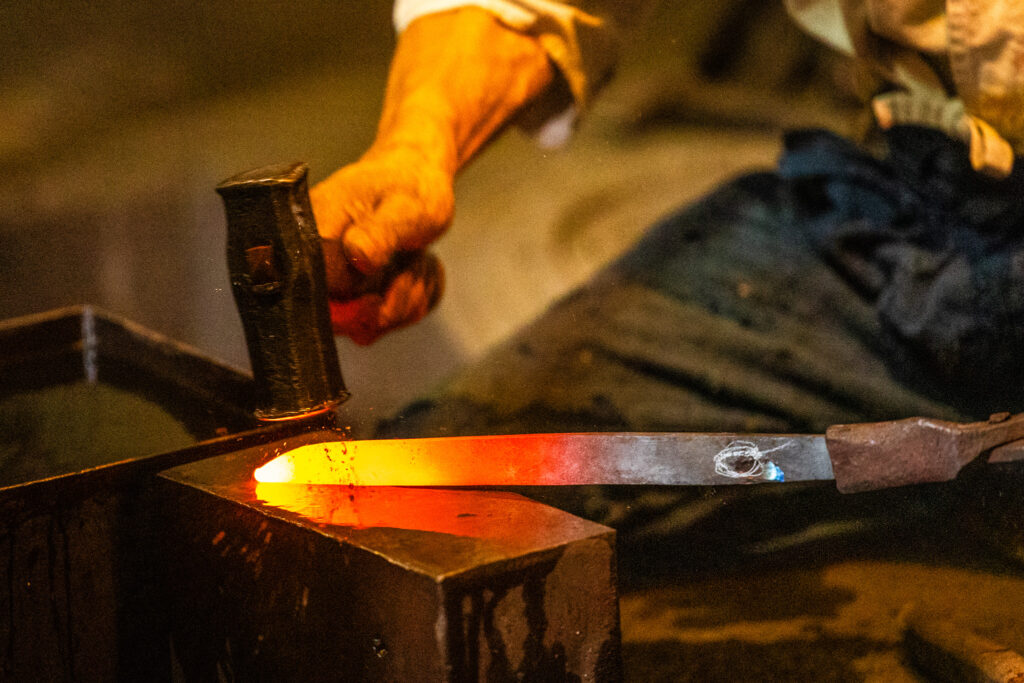
Once the steel had been prepared, the swordsmith gradually formed the blade.
Heating made the steel workable. Hammering changed its shape and structure. The smith had to control both while maintaining the proportions required for the finished blade.
This is where the image of the swordsmith surrounded by sparks can be slightly misleading.
The dramatic moment of striking hot steel may be visually impressive, but Japanese blade-making is also a craft of careful observation and control.
Too much or too little heat can affect the material. The thickness and shape of the blade have to be considered throughout the process. Small decisions made at one stage can influence what becomes possible at the next.
The blade is not created in one dramatic act.
It develops through a sequence of controlled decisions.
Creating a Cutting Edge
One of the most important stages is heat treatment.
Traditionally, a clay mixture is applied thinly near the cutting edge and more thickly over other areas of the blade before heating and quenching. This helps control how quickly different areas cool.
The cutting edge hardens, while other areas remain comparatively softer and more resistant to fracture. This differential hardening produces the distinctive hamon, a visible pattern marking the transition between the hardened edge region and the less-hardened body of the blade.
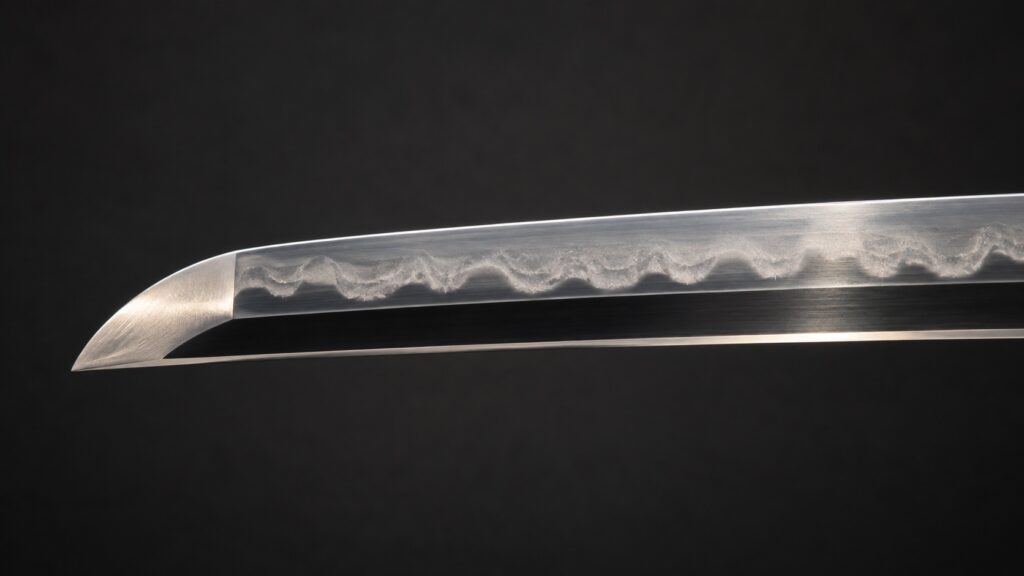
This balance matters because a useful blade cannot be judged by hardness alone.
A blade that is extremely hard but too brittle can fail. One that is tough but unable to maintain a fine edge will not perform as required.
The maker therefore has to think about different properties of the material at the same time.
The Blade Is Not Finished at the Forge
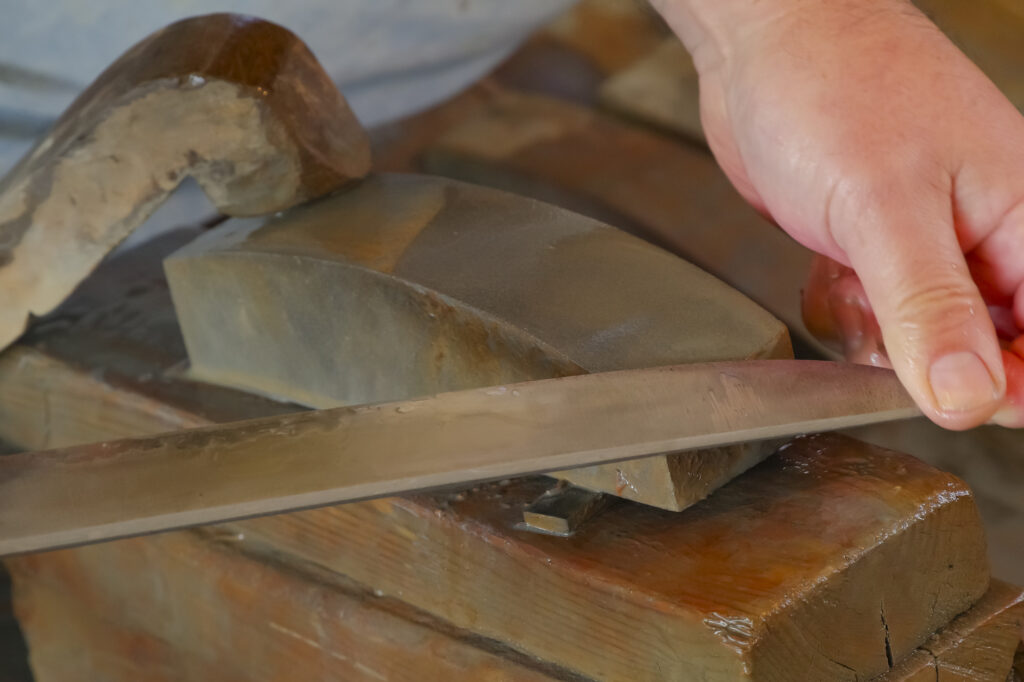
Forging creates the blade, but it does not create the finished surface and cutting edge we associate with a Japanese sword.
Traditionally, specialist polishers carry out the final sharpening and polishing after the swordsmith has forged, heat-treated and roughly finished the blade.
Japanese sword polishing is itself a highly skilled process. A sequence of stones is used to refine the blade, correct its geometry and gradually reveal details created during forging and heat treatment.
This stage illustrates something important about Japanese blade craftsmanship: sharpness is only one part of the result.
Geometry, surface, material and finishing all influence how a blade performs.The finished object is therefore the result not only of the swordsmith's work, but of specialised skills at different stages of production.
From Swords to a Wider Culture of Blade-Making
The Japanese sword belongs to a particular tradition and should not be treated as simply an early version of today's kitchen knife or hairdressing scissors.
Modern tools have their own histories, materials, manufacturing methods and purposes.
But the long development of Japanese blade-making helped establish something broader: a deep culture of understanding steel and the cutting edge.
Across different Japanese blade-making regions and industries, craftspeople continued working with questions that sound surprisingly modern:
How should the steel be treated?
What kind of edge is required for a particular task?
How should hardness and toughness be balanced?
How does the shape of a blade affect the way it cuts?
And how much of the final performance depends on finishing?
The answers are different for a sword, a kitchen knife and a pair of professional scissors.
The underlying attention to the relationship between material, purpose and precision, however, remains striking.
From the Shape of a Sword to the Shape of a Tool
The katana is widely recognized for its curved, single-edged blade. Its shape was not simply aesthetic: blade geometry, heat treatment and polishing all contributed to how the finished blade performed.
The same principle — that the shape and structure of a blade should reflect its purpose — can also be seen in traditional Japanese kitchen knives today.
A yanagiba, for example, uses a long, single-bevel blade for smooth slicing, while a deba is thicker and more robust for working with fish. An usuba uses a thin, single-bevel blade for precise vegetable work. These knives are not simply modern versions of the Japanese sword, nor do they all share the same construction. What they do share is an emphasis on matching steel, blade geometry and craftsmanship to a specific task.
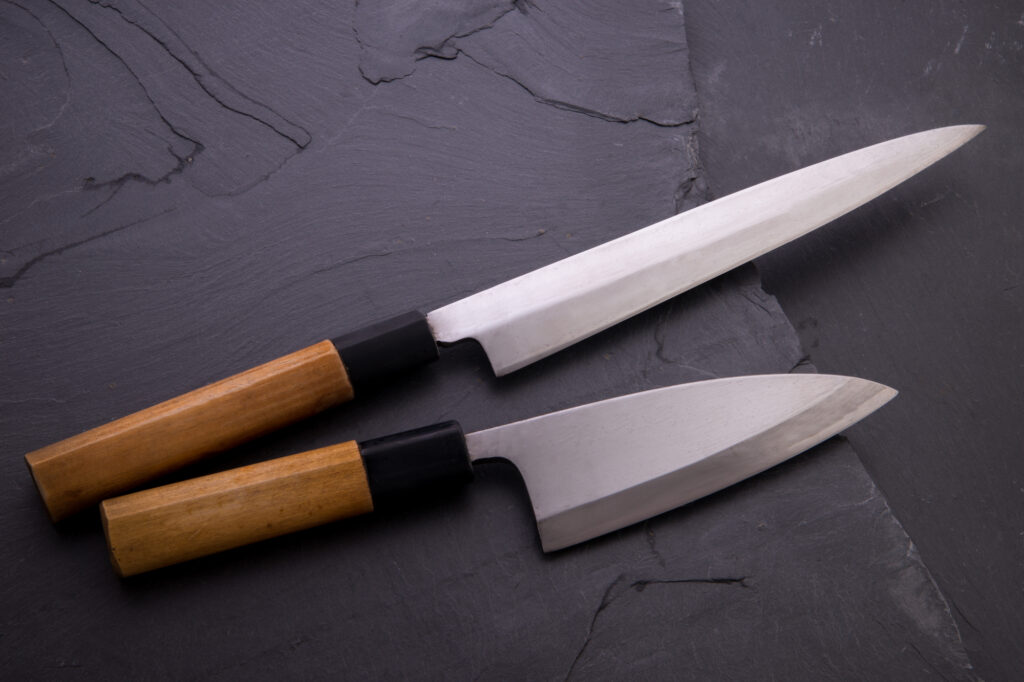
In other words, the story is not simply about preserving an old blade shape. It is about continuing to ask the same practical question: what should this blade be able to do?
Different Tools, Different Demands
A chef's knife is designed to move through food efficiently and repeatedly. A pair of professional hairdressing scissors needs two precisely interacting blades and must cut hair cleanly with minimal pushing or bending of the strands.
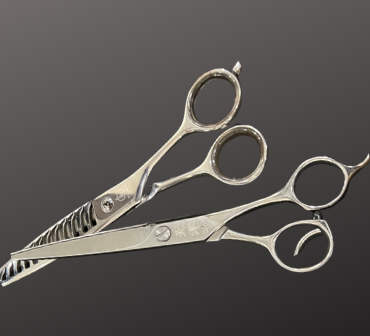
Neither is a sword in miniature.
That distinction is important.
What connects these tools is not necessarily an unchanged technique handed directly from the swordsmith to the modern manufacturer. It is a broader manufacturing culture in which the properties of steel, blade geometry, heat treatment, sharpening and finishing receive extraordinary attention.
Today, these principles may be combined with modern metallurgy, specialised steels, precision machinery and contemporary production techniques.
Tradition does not have to mean making things exactly as they were made centuries ago.
Sometimes its influence is found in the knowledge that continues to evolve.
A Legacy That Continues to Evolve
Perhaps that is the most interesting legacy of the Japanese swordsmith.
The sword itself is no longer an everyday cutting tool. The world in which it developed has changed completely.
But the challenge faced by the maker has not disappeared:
How do you turn steel into a tool that performs exactly as intended?
Modern Japanese craftspeople and manufacturers answer that question in many different ways — from traditional forging to advanced steel technology and precision manufacturing.
We can see the results in objects as different as kitchen knives and professional hairdressing scissors.
And when we look closely at those tools, their value often lies not simply in the material from which they are made, but in the decisions made about that material along the way.
Today, that relationship between steel, skill and precision can still be seen in Japanese tools made for professionals.